

The Sticky Nightmare Nobody Talks About
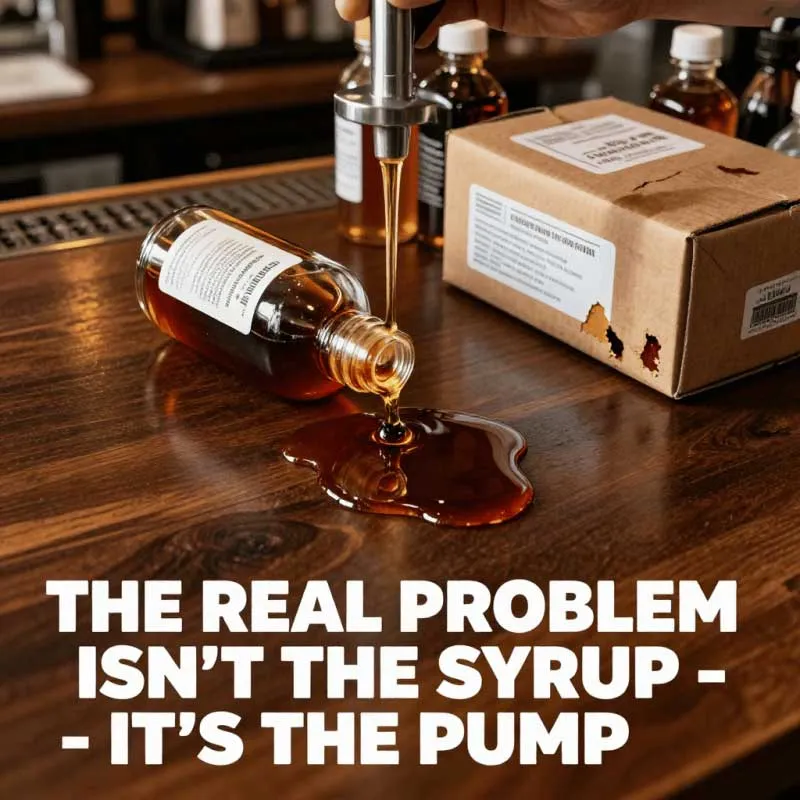
Imagine arriving at your café in the morning and finding a sticky syrup puddle spreading across your coffee bar.
Or worse.
Your online customers receive their coffee syrup bottles only to discover syrup leaking inside the shipping carton. Labels are damaged, boxes are stained, and refund requests start appearing.
For many syrup brands, coffee shops, and foodservice distributors, leaking dispensers are more than a minor inconvenience-they create wasted product, unhappy customers, increased cleaning costs, and damaged brand reputation.
The surprising part?
In most cases, the problem isn't the syrup.
It's the coffee syrup pump dispenser system itself.
After supplying glass bottles and dispensing solutions to food and beverage brands worldwide, we've found that most leakage problems can be traced back to a few avoidable mistakes.
Let's examine the real causes.
causes Study
Check and avoid your pump leakage
Cause #1: The "28-400" Thread Mismatch
One of the most common misconceptions in the industry is:
"If both components are 28-400, they should fit perfectly."
Unfortunately, that's not always true.
Many buyers source glass bottles from Supplier A and purchase syrup pumps from Supplier B in an effort to reduce costs.
While both products may technically use a 28-400 pump dispenser specification, manufacturing tolerances often vary from factory to factory.
Even a small deviation in thread dimensions can create:
Loose sealing
Air leakage
Product seepage
Pump instability
Shipping failures
This issue becomes even more noticeable with thick products such as:Vanilla syrup, Caramel syrup, Hazelnut syrup, chocolate sauce, and flavor concentrates
When the bottle neck finish and pump closure are not engineered together, leakage becomes almost inevitable.
01
Cause #2: The Dip Tube Length Problem
Many syrup dispensing issues start below the cap.
The dip tube is the long tube extending from the pump into the bottle.
Its length matters more than most buyers realize.
If the Dip Tube Is Too Short
The pump stops dispensing while syrup remains at the bottom of the bottle.
This creates:
Product waste
Customer frustration
Reduced perceived value
A few millimeters may not sound significant, but over thousands of bottles, the losses become substantial.
If the Dip Tube Is Too Long
The tube can bend or curl inside the bottle.
This may result in:
Reduced flow rate
Air entering the system
Uneven dispensing
Difficulty priming the pump
The ideal dip tube should stop slightly above the bottle bottom while maintaining unrestricted liquid flow.
For commercial syrup dispensers, precision matters.
02
Cause #3: Shipping Vibration Damage
Many syrup brands focus on production quality but overlook transportation conditions.
During international shipping, products may experience:
Long-distance trucking
Ocean freight vibration
Warehouse handling
Parcel courier sorting
If a pump is not secured properly, vibration can gradually loosen the closure.
The result?
A perfectly sealed bottle at the factory arrives leaking at the customer's door.
This issue is especially common for:
Amazon FBA sellers
Shopify brands
E-commerce distributors
Subscription box businesses
A standard pump may work perfectly on a café counter but fail during transportation.
This is why many leading brands now prefer a lockable syrup pump or Twist-to-Lock pump system.
When locked, accidental actuation during transit is prevented, dramatically reducing leakage risk.
03
Cause #4: Poor Gasket Quality
The sealing gasket is often the most overlooked component of a syrup bottle pump system.
A low-quality gasket may:
Compress unevenly
Crack over time
Lose elasticity
Fail under temperature changes
Even when the threads match perfectly, a poor gasket can allow syrup to escape around the neck finish.
For foodservice applications, gasket materials should be selected based on:
Syrup viscosity
Storage temperature
Product acidity
Transportation requirements
A leak-proof syrup pump depends on the quality of every component-not just the visible parts.
04
@Glass Solution: Pre-Tested Bottle & Pump Systems
Before mass production, to do a real usage test to make sure all fit well.
@Glass, we approach the problem differently.
We don't simply manufacture glass bottles and pumps. We provide complete dispensing solutions.
Precisely Matched Components
Every bottle and pump combination is tested for compatibility before production. This helps eliminate:
- Thread mismatch
- Seal failures
- Leakage complaints
Millimeter-Accurate Dip Tube Cutting
Instead of supplying standard-length tubes, we cut dip tubes according to the exact bottle height. This ensures:
- Maximum syrup evacuation
- Smooth dispensing
- Better user experience
Twist-to-Lock Technology
Our professional coffee syrup pump dispensers feature secure lockable designs that help protect products during transportation and storage.
Custom Packaging Options
| Custom Syrup Bottles | shape, size, neck finish, and emboss pattern can be customized |
| Bottle Material Selection | soda-lime glass, borosilicate glass, PET, and PP material, all of which are food-grade |
| Logo and Label | can be printed on the bottle surface, or a label sticker can be applied |
| Custom Pumps | The pump's size, color, logo, and dip tube length can be customized |
Whether you are launching a new syrup brand or supplying a national café chain, our team can provide a complete bottle-and-pump solution from a single source.


Frequently Asked Questions
Why is my syrup pump leaking around the bottle neck?
The most common causes are thread mismatch, poor gasket quality, or insufficient sealing torque.
Are all 28-400 pumps compatible with all 28-400 bottles?
No. Manufacturing tolerances vary between suppliers. Compatibility testing is always recommended.
What is the ideal dip tube length?
Typically, the tube should stop approximately 2–5 mm above the bottle bottom for optimal performance.
What is a lockable syrup pump?
A lockable or Twist-to-Lock pump can be secured during storage and transportation to reduce accidental dispensing and leakage.
Can I order glass bottles and pumps together?
Yes. Purchasing a pre-tested bottle and pump system significantly reduces compatibility risks and improves packaging reliability.
Final Thoughts
A leaking coffee syrup pump dispenser is rarely caused by a single defect.
In most cases, the issue stems from mismatched components, improper dip tube length, poor sealing materials, or transportation-related stress.
The good news is that all of these problems can be prevented.
Choosing a professionally tested bottle and pump combination can save your business from product waste, customer complaints, and costly returns.
Because when it comes to syrup packaging, the cheapest solution is rarely the most economical one.
Stop the Leaks Before They Start
Looking for a reliable coffee syrup pump dispenser, leak-proof syrup pump, or custom glass syrup bottle supplier?
Contact our team today and request a sample of our pre-tested bottle and pump system.


