

Pharmaceutical & Nutraceutical Glass Packaging
| Bottles for Capsules, Syrups & Oils
Premium Glass Packaging for Pharmaceuticals, Nutraceuticals, and Wellness Brands. Meeting USP/EP standards with certified Light Protection and Child-Resistant safety solutions. Wholesale Wide Mouth Packers, Syrup Bottles, and Dropper Bottles. FDA/DMF compliant with Child-Resistant (CRC) closure solutions.
The Product Triad | Specialized Solutions for Every Formulation
Category A: Solid Dose & Capsules

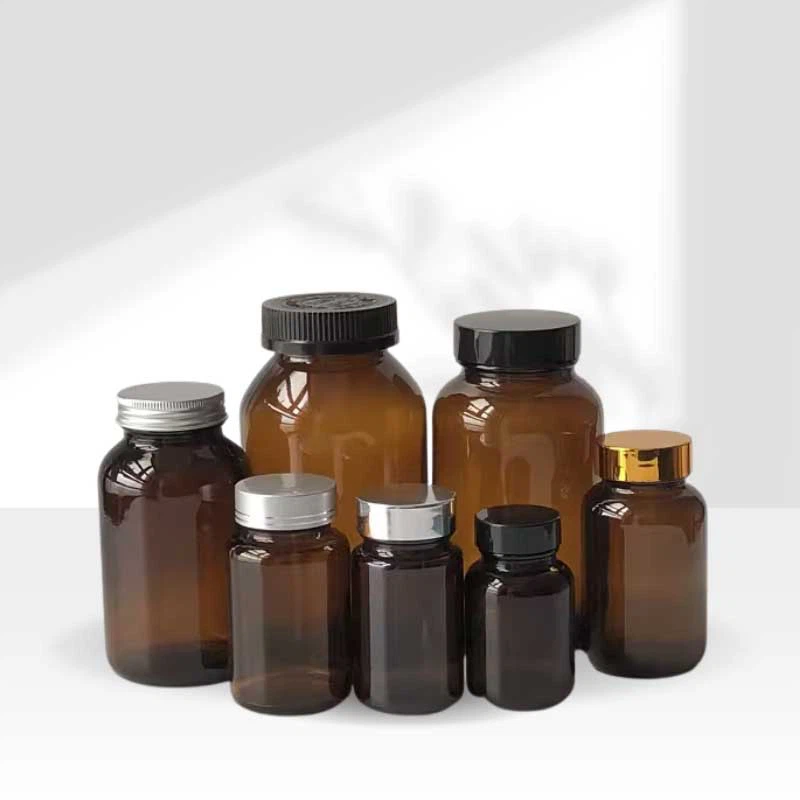
Glass wide-mouth Bottle with CRC Closures
Amber wide-mouth glass jars are designed for products that require reliable light protection and stable storage performance. The amber coloration helps reduce UV exposure, making these jars an ideal packaging choice for light-sensitive contents across food, pharmaceutical, and industrial sectors.
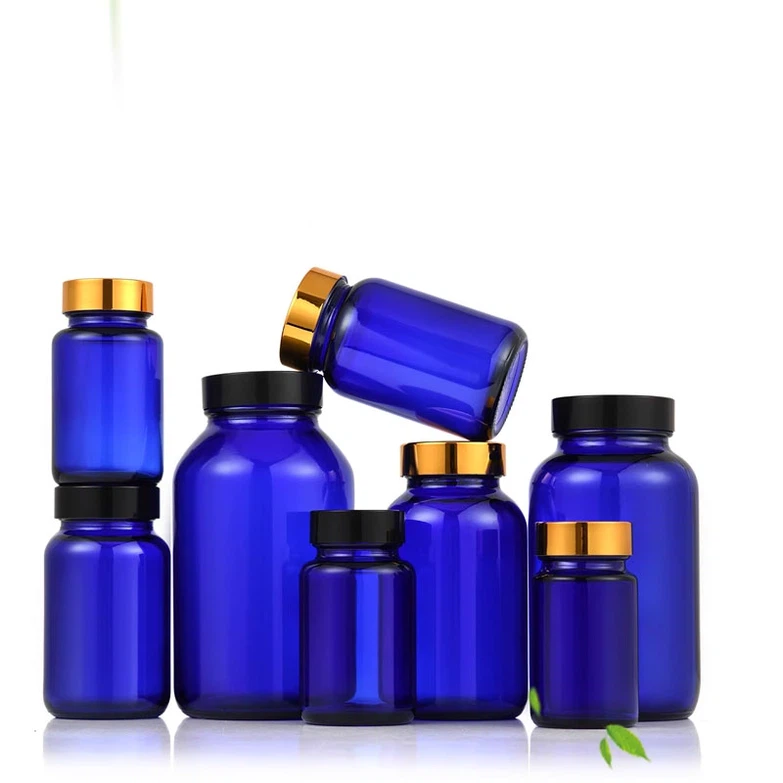
Glass wide-mouth Bottles & Caps
Cobalt blue wide mouth glass jars combine distinctive visual appeal with functional storage performance, making them a popular choice for premium products and brand-focused packaging. The deep blue color enhances shelf presence while also offering moderate light filtration.
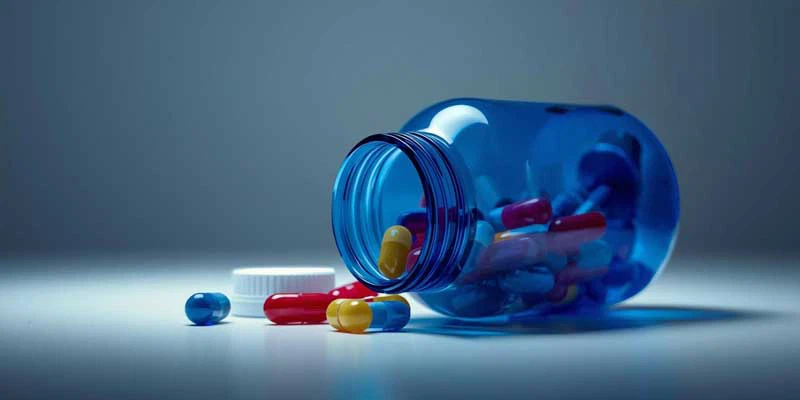
Product Advantages
| Color | Clear, Frost, Black, Amber, Cobalt Blue |
| Sizes | Available in 60ml, 75ml, 100ml, 120ml, 150ml, 200ml, 250ml, 300ml, 400ml, and 500ml |
| Caps | plastic cap, CRC, aluminum cap |
UV-Resistant
Amber glass naturally limits light transmission, supporting longer shelf life for sensitive powders, capsules, herbs, and chemical materials.
Functional Wide Mouth Opening
The wide neck allows easy filling, dispensing, and inspection, suitable for both manual handling and automated packaging lines.
Durable & Non-Reactive Material
Manufactured from high-quality glass with excellent chemical resistance, ensuring product purity and compliance with food and pharmaceutical standards.
Closure Compatibility
These wide mouth glass jars can be paired with various plastic screw caps as well as child-resistant closures (CRC), providing options for tamper resistance, safety compliance, and secure sealing.
Liquid Medicine & Syrups Bottles
Lorem ipsum dolor sit amet consectetur adipisicing elit.
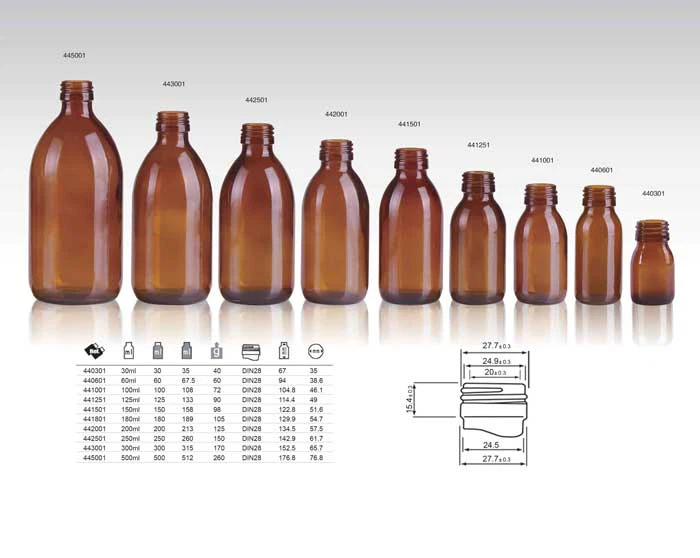
Amber Glass Bottles for Syrups, DIN 28
Designed for cough syrups, tinctures, and liquid supplements. Our bottles feature precise neck finishes to accommodate dosing cups and oral syringes.
Specifications:
| Item | Volume | Weight | Height(mm) | Diameter(mm) |
| 440301 | 30ml | 40g | 67 | 35 |
| 440601 | 60ml | 60g | 94 | 38.6 |
| 441001 | 100ml | 72g | 104.8 | 46.1 |
| 441251 | 125ml | 90g | 114.4 | 49 |
| 441501 | 150ml | 98g | 122.8 | 51.6 |
| 441801 | 180ml | 105g | 129.8 | 54.7 |
| 442001 | 200ml | 125g | 134.5 | 57.5 |
| 442501 | 250ml | 150g | 142.9 | 61.7 |
| 443001 | 300ml | 170g | 152.5 | 65.7 |
| 445001 | 500ml | 260g | 176.8 | 76.8 |
Clear Glass Syrup Bottles | dIN 28
Manufactured from high-quality transparent glass, these bottles are suitable for pharmaceutical, nutraceutical, and food-grade syrup applications.
Designed with a DIN28 neck, ensuring precise compatibility with standardized closures and dispensing systems commonly used in pharmaceutical packaging.
| Color | Clear or Frost |
| Size | 30ml, 60ml, 90ml, 125ml, 150ml, 200ml |
| Cap | PP 28 caps, aluminum cap |


Amber Glass Boston Bottles | GPI 400
Amber Glass Boston Bottles with GPI 400 neck finish are a versatile and industry-standard packaging solution designed for liquid and semi-liquid products that require UV protection, secure sealing, and broad closure compatibility. These bottles are widely used across pharmaceutical, cosmetic, laboratory, and food sectors.
Specifications
| Item | Volume | Weight | Finish |
| 430151 | 15ml | 25.5g | GPI 18-400 |
| 430301 | 30ml | 44g | GPI 20-400 |
| 430601 | 60ml | 56g | GPI 20-400 |
| 431201 | 120ml | 108g | GPI 22-400 |
| 432401 | 240ml | 175g | GPI 28-400 |
| 434801 | 480ml | 255g | GPI 28-400 |
| 439601 | 960ml | 480g | GPI 28-400 |
Amber Dropper Dispensing Bottles | DIN 18mm
Manufactured from high-quality amber glass, these bottles help reduce UV light transmission, supporting the stability and shelf life of light-sensitive liquids. The DIN 18mm standard neck ensures consistent compatibility with a variety of dispensing closures, making these bottles suitable for both small-batch and large-scale production.
Key Features
Protective Amber Glass
Amber glass offers reliable UV resistance, ideal for essential oils, herbal extracts, and pharmaceutical liquids that degrade under light.
DIN 18mm Standard Neck
The DIN 18mm finish allows precise matching with standardized droppers, sprayers, and dispensing caps, ensuring leak-resistant performance.
Wide Size Selection
Available in 5ml, 10ml, 15ml, 20ml, 30ml, 50ml, and 100ml, covering sample sizes through retail and professional-use packaging.
Durable Glass Construction
Thick, uniform glass walls provide strength and stability during filling, transport, and daily use.


FAQs
Q1: What is the difference between USP Type I, Type II, and Type III glass in your catalog?
A:
Type I (Borosilicate): Maximum chemical resistance, neutral pH. Ideal for parenteral (injectable) drugs and strong chemicals.
Type II (Treated Soda-Lime): Soda-lime glass with a de-alkalized surface treatment (Sulfur treatment) for buffered acidic/neutral aqueous solutions.
Type III (Soda-Lime): Standard flint or amber glass used for oral solids, syrups, and oils. This is our most popular material for the Apothecary line.
Q2: What is the difference between "Molded Glass" and "Tubing Glass" vials?
A: Molded Glass is formed in a mold (like standard bottles), offering higher durability and lower cost for larger volumes (Syrups/Packers). Tubing Glass is drawn from a glass tube, offering uniform wall thickness and a flatter bottom, ideal for small diagnostic vials (2ml-30ml) and premium serum samples.
Q3: Does your Amber glass meet light transmission standards for light-sensitive drugs?
A: Yes. Our Amber glass adheres to USP <660> and EP 3.2.1 standards for light transmission, blocking light wavelengths between 290nm and 450nm to prevent photochemical degradation of sensitive ingredients.
Q4: Is your Cobalt Blue glass just painted?
A: No. Our Cobalt Blue glass is colored in the furnace using cobalt oxide. The color is integral to the glass material, meaning it will never peel, scratch off, or interact with solvents like alcohol or acetone.
Q5: What is the "Hydrolytic Resistance" of your glass?
A: Our Borosilicate glass meets HGB1 / ISO 719 hydrolytic resistance class, ensuring minimal alkali release into the liquid, which is critical for maintaining the pH stability of high-potency serums.
Q6: Are your bottles lead-free and arsenic-free?
A: Absolutely. All our pharmaceutical and cosmetic glass containers are tested to be free from heavy metals (Lead, Cadmium, Arsenic, Mercury), complying with California Prop 65 and REACH regulations.
Q7: How does the "Euro Dropper" mechanism work?
A: The Euro Dropper consists of a cap and a specific insert (dripolator) that sits in the bottle neck. It relies on gravity and an air-return hole to dispense liquids drop-by-drop. It is ideal for essential oils where precise, slow dosing is required without a glass pipette.
Q8: What flow rates do your Orifice Reducers offer?
A: We offer varied orifice sizes tailored to your liquid's viscosity: 0.6mm for thin alcohol-based liquids, 1.0mm for standard essential oils, and 1.5mm for thicker carrier oils to ensure a consistent flow.
Q9: Do your Glass Pipette Droppers reach the bottom of the bottle?
A: Yes. We custom-manufacture the glass pipette length to match the specific height of our Boston Round bottles, ensuring the tip sits just above the bottom to maximize product usage.
Q10: Are your Spray Pumps suitable for high-viscosity lotions?
A: Standard mist sprayers are for thin liquids (water/alcohol). For lotions or creams, we supply Treatment Pumps (Cream Pumps) with a larger output (e.g., 0.2cc - 0.5cc per stroke) and a wider dip tube to handle viscosity.
Q11: What is the protocol for Child-Resistant (CRC) Certification?
A: Our CRC caps are tested according to 16 CFR 1700.20 protocols. They require two simultaneous motions (Push Down + Turn) to open, preventing children under 5 from accessing the contents while remaining accessible to seniors.
Q12: Can you provide "Tamper-Evident" (TE) rings for droppers?
A: Yes. We offer dropper assemblies with an integrated TE Break-away Band. When the customer unscrews the dropper for the first time, the plastic ring detaches and stays on the bottle neck, proving product integrity.
Q13: Do you offer Phenolic Caps (Bakelite)?
A: Yes. We supply Black Phenolic caps with Polycone liners. These form an exceptionally tight wedge seal against the inside of the neck, ideal for harsh chemicals, acids, and alkalis.
Q14: Are the bottles washed before shipping?
A: Standard industrial bottles are not pre-washed. However, for pharmaceutical clients, we offer "Clean Pack" services where bottles are shrink-wrapped in a controlled environment to minimize dust and bio-burden, ready for your washing/sterilization tunnel.
Q15: What is the dimensional tolerance for the bottle neck?
A: For pharma bottles, neck precision is critical for closure fit. Our tolerance is typically ±0.3mm to ±0.5mm depending on the neck size (DIN 18, GPI 20-400, etc.), ensuring compatibility with high-speed capping machines.
Q16: Can you print "Graduation Marks" (Measurement Lines) on the dropper pipette?
A: Yes. We can print calibrated dosage lines (e.g., 0.25ml, 0.5ml, 1.0ml) in black or white ink directly on the glass pipette for precise medication dosing.
Q17: Can you produce "Matte Black" or "Matte White" bottles for a modern look?
A: Yes. We use an eco-friendly, opaque Spray Coating to achieve a matte finish. This also provides 100% light blocking for extremely photosensitive formulas.
Q18: Can you do Ceramic Screen Printing for small 10ml vials?
A: Yes. Even for small diameters, we have precision rotary screen printing machines that can apply your logo and dosage instructions clearly. Ceramic ink is fired onto the glass, making it scratch-resistant and alcohol-resistant.
Q19: Do you offer rectangular or square "French Pharmacy" style bottles?
A: Yes. We have stock molds for the classic Rectangular Syrup shape (often used for men's grooming or vintage cough syrup aesthetics) in Amber and Flint glass.
Q20: How are small vials (e.g., 5ml, 10ml) packed to prevent tipping and breakage?
A: Small vials are typically "Module Packed" (shrink-wrapped in small bricks) or placed in Plastic Trays. This keeps them upright and organized for easy feeding into your filling machine.
Q21: Can I buy just the glass pipettes without the rubber bulbs?
A: Yes. We sell components separately. You can purchase glass tubes, rubber bulbs (Nitrile/Silicone), and plastic collars independently if you have your own assembly line.
Q22: Do you supply Siliconized Glass bottles?
A: We can provide siliconization treatment for the internal surface of the bottles. This is often required for high-viscosity liquids to ensure maximum drainage (reduce product waste).
Q23: What is the MOQ for custom colored rubber bulbs (e.g., Pink or Gold)?
A: Standard bulbs are Black/White. Custom Pantone color rubber bulbs typically require an MOQ of 10,000 to 20,000 pieces due to the rubber mixing process.
Q24: Can you ship "Sets" (Bottle + Dropper) unassembled?
A: Yes. Most clients prefer them unassembled for filling. We ship bottles in cartons/pallets and closures in separate bags to ensure hygiene and filling efficiency.
Q25: Do you offer "Sterile" Ready-to-Use (RTU) vials?
A: Generally, we supply non-sterile bulk glass. RTU sterile vials require specific cleanroom processing and EtO/Gamma sterilization, which is a specialized service we can discuss for high-volume contracts.
Q26: Can I get samples of the dropper to test with my specific oil viscosity?
A: Highly recommended. Different oils (carrier oil vs. essential oil) drip differently. We will send a Sample Kit with various orifice sizes so you can test the flow rate before ordering.
Q27: What neck finishes do you offer for pharma bottles?
A: We support global standards, including DIN 18 (European dropper standard), GPI 18-400 / 20-400 / 22-400 / 24-400 (US Standards), and PP28 (Syrup standard).
Q28: Are your rubber bulbs compatible with aggressive essential oils?
A: Yes. We offer Nitrile and Viton bulbs, which have superior resistance to aggressive essential oils and citrus oils compared to standard natural rubber, preventing swelling or degradation.
Secure Your Supply Chain.
@Glass, your reliable, compliant, and scalable glass packaging for the health industry.