

Glass bottle quality control is not simply about finding bottles that "look bad."
For a packaging buyer, the more important question is whether the bottle is suitable for the intended filling, closing, handling, transportation and end-use conditions.
A bottle can appear acceptable but still present problems if its dimensions, finish geometry, capacity, wall distribution or physical properties do not meet the requirements of the packaging system. Conversely, some visual characteristics may have different acceptance requirements depending on the application and agreed specification.
That is why effective glass packaging quality control should begin before production, with clearly defined product requirements and acceptance criteria.
At Global Bottles & Jars, our manufacturing experience spans 41 years. Based on that experience, this guide explains the major categories of glass bottle defects, how they can relate to manufacturing, what quality inspections may be relevant, and what buyers should clarify with a supplier before approving production.
Buyer takeaway: Good quality control is not simply "inspect more bottles." It is the process of translating your packaging requirements into measurable manufacturing and inspection criteria.
1. What Is Glass Bottle Quality Control?
Glass bottle quality control is the systematic process used to evaluate whether manufactured glass containers meet defined requirements for:
- appearance and dimensions;
- capacity and weight;
- bottle finish and geometry;
- physical and mechanical performance;
- compatibility with the intended packaging application.
The exact inspection and acceptance requirements should depend on the bottle design, contents, closure system, filling process, distribution conditions and applicable customer or market requirements.
This distinction matters.
A spirits bottle, beverage bottle, cosmetic bottle, pharmaceutical container and candle jar do not necessarily face the same functional risks.
Therefore, there is no useful one-size-fits-all quality-control plan for every glass container project.
2. Why Glass Bottle Quality Control Matters to Buyers
Quality problems rarely remain confined to the bottle factory. They can affect later stages of the packaging supply chain.
For example, dimensional or forming problems may interfere with filling-line handling. Finish-related problems may affect closure application or sealing. Certain internal glass defects or cracks can reduce container integrity. Visible defects can also affect the appearance expected from premium packaging.
For buyers, quality control therefore protects more than appearance. It helps reduce risks related to:
- filling-line performance;
- closure compatibility & sealing;
- transportation-way & breakage;
- packaging consistency & brand presentation;
The most effective approach is to identify these risks during specification development rather than waiting until finished bottles arrive.
3. Where Do Glass Bottle Defects Come From?
Glass bottle defects can originate at different stages of manufacturing.
These may include:
- raw-material and batch preparation;
- melting, refining, forming, & mold interaction
- homogenization and conditioning;
- handling and downstream processing.
For practical quality analysis, defects can be divided into two broad groups:
Glass-body defects - irregularities or inclusions within the glass itself.
Forming defects - defects created or expressed as the container is formed into its final geometry.
Understanding this distinction helps buyers and manufacturers investigate defects by probable process origin rather than treating every problem as a cosmetic issue.
4. Common Glass-Body Defects
4.1 Bubbles
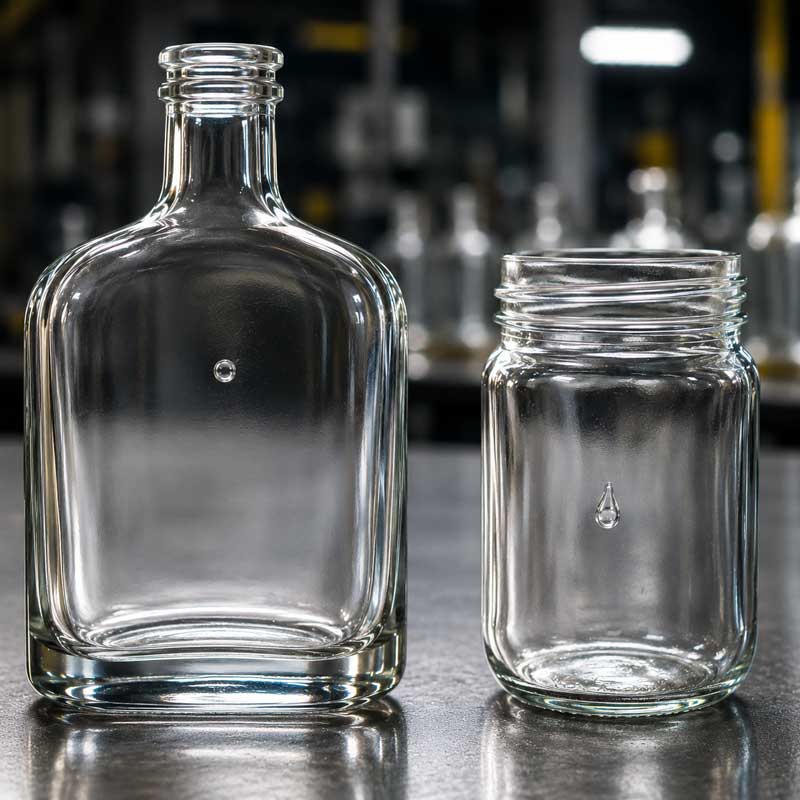
Bubbles are visible gaseous inclusions inside the glass.They can vary in size and shape and may appear spherical, elongated or irregular.
Their importance depends on characteristics such as: size, number, location, and intended application
Bubbles can originate from different stages or conditions associated with glass melting, refining, raw materials, cullet, refractory interaction or process conditions.
Why buyers should care
Bubbles can affect visual quality and glass uniformity. Depending on their characteristics and location, they may also be relevant when evaluating container integrity.
A premium spirits or fragrance bottle, for example, may have much stricter visual expectations than a container where optical appearance is less critical.
Buyer question
Instead of asking: "Are bubbles allowed?"
Ask: "What bubble acceptance criteria will apply to this bottle, considering size, quantity, location and application?"
Acceptance limits are project-dependent and should be confirmed before production.
4.2 Stones and Solid Inclusions
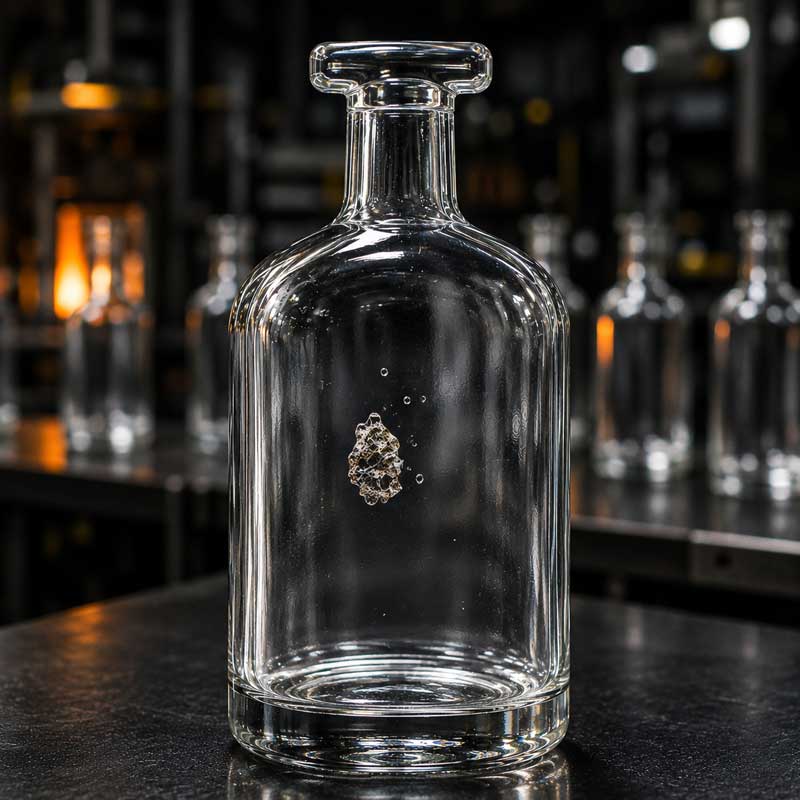
Stones are solid crystalline or foreign inclusions within the glass body.
Possible origins include:
- incompletely melted batch components;
- refractory material;
- crystallization;
- sulfate-related inclusions;
- foreign contamination.
Stones deserve particular attention because their physical properties may differ from the surrounding glass.
This difference can create localized stress and affect the uniformity of the container.
Buyer implication
Do not evaluate inclusions solely according to how visible they are.
An inclusion that looks small may require greater attention than a larger cosmetic imperfection depending on its nature and location.
This is why defect classification is more useful than a simple "good-looking / bad-looking" inspection.
4.3 Cords and Knots
Cords and knots are glassy inhomogeneities whose composition or physical characteristics differ from the surrounding glass.
They may appear as: lines, streaks, fibers, localized raised or distorted areas.
They can be associated with incomplete homogenization, differences within the glass melt, refractory interaction or other melting-related conditions.
Why they matter
They can affect visual uniformity and create localized differences within the glass body.
For lightweight containers, control of glass homogeneity and distribution becomes especially important because less material is available to accommodate variations.
5. Common Glass Bottle Forming Defects
Glass forming is a highly controlled process, but multiple variables interact during container formation.
Glass temperature, mold condition, cooling, forming timing and mechanical alignment can influence the final glass bottle.
Common forming-related defects include:
| Defect | What the Buyer May Observe | Potential Buyer Risk |
|---|---|---|
| Body deformation | Dented, bulged or distorted bottle | Filling-line or appearance issues |
| Verticality deviation | Bottle appears tilted | Handling or filling-line problems |
| Uneven wall distribution | Localized differences in glass distribution | Performance inconsistency |
| Finish deformation | Finish is visibly distorted | Closure/sealing compatibility risk |
| Cracks | Fine or visible fracture lines | Container integrity risk |
| Heavy mold seams | Pronounced seam lines | Appearance or handling concern |
| Fins / flash | Thin protruding glass along mold joints | Handling and packaging concern |
| Stones/inclusions | Solid particles inside glass | Integrity and appearance concern |
| Bubbles | Gas inclusions | Appearance and potentially performance concern |
| Cords/knots | Streaks or non-uniform glass | Appearance and glass uniformity concern |
This table is a sourcing guide rather than an acceptance standard. Actual acceptance criteria must be defined for the individual project.
5.1 Deformation and Verticality Problems
Bottle deformation can include dents, bulges and general shape distortion.
Excessive vertical-axis deviation can cause a bottle to stand or travel through equipment incorrectly.
For buyers using automated filling and packaging lines, geometry can therefore become a functional requirement rather than a purely cosmetic one.
A bottle that is acceptable when inspected individually may still create problems when thousands of units move through conveyors, filling equipment, capping equipment or labeling systems.

Manufacturing considerations
Forming temperature, mold temperature, cooling and forming conditions can contribute to these problems.
The precise process adjustment depends on the defect and production conditions.
Buyer recommendation
Provide the manufacturer with relevant downstream information when possible, including:
- filling method;
- conveyor handling;
- closure system;
- labeling method;
- decoration requirements;
- critical equipment interfaces.
This gives the supplier more context for identifying critical dimensions and quality characteristics.
5.2 Uneven Glass Distribution
Uniform glass distribution is an important manufacturing consideration.
A bottle may meet its overall weight requirement while still having uneven local glass distribution.
This is why bottle weight alone should not be treated as proof of structural consistency.
Possible manufacturing influences include forming conditions, glass temperature, mold conditions and process adjustments.
Buyer mistake
A common sourcing mistake is specifying only:
- bottle weight;
- capacity;
- overall dimensions.
A stronger specification also considers the functional characteristics that matter to the packaging system.
Project-specific wall-thickness requirements and measurement methods: Factory confirmation required.
5.3 Finish Defects: Small Area, Large Consequences
The finish is one of the most functionally important areas of a glass bottle because it interfaces with the closure.
Problems may include:
- finish deformation;
- rough or irregular sealing surfaces;
- dimensional deviation;
- cracks around the finish;
- excessive glass or flash.
A bottle can have an attractive body and still fail as a packaging component if its finish does not work correctly with the selected closure.
For buyers, the bottle and closure should be treated as a system.
Before mass production, confirm the intended:
- closure type;
- finish specification;
- sealing interface;
- application requirements.
For customized packaging, closure compatibility should be considered during bottle development rather than after the bottle has already been finalized.

5.4 Cracks: One of the Most Important Defect Categories
Cracks are among the most serious glass container defects because they can affect container integrity.

They may occur around different areas of the bottle, including:
- finish;
- neck;
- body;
- internal surfaces;
- base.
Their origins can involve thermal effects, mechanical forces, forming conditions, mold-related conditions or handling.
Small cracks can also be more difficult to detect than obvious fractures.
Buyer implication
A crack should not be evaluated only according to visual appearance.
Its location, depth, orientation and effect on container integrity matter.
For this reason, crack inspection should form part of the agreed quality-control approach.
Specific crack classification and acceptance criteria: Factory confirmation required.
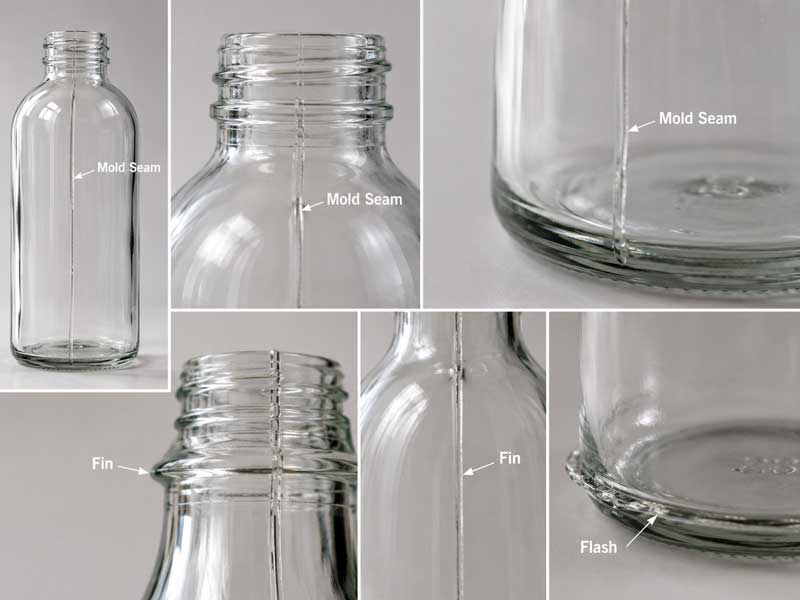
5.5. Mold Seams, Fins and Flash
Because bottles are formed in molds, mold-joint lines cannot simply be discussed as if every visible seam is automatically a defect.
The key issue is whether the seam condition remains within the agreed product requirement.
Excessive mold seams can be associated with mold condition, glass temperature, mold closing conditions, contamination or forming adjustments.
More severe conditions can produce fins or flash-thin projections of glass around mold interfaces. These are especially important around:
- bottle body mold joints;
- finish areas;
- bottle heel and base interfaces.
Buyer lesson
Define the acceptable appearance level before production, especially for premium cosmetic, fragrance and spirits packaging where visual expectations can be high.
6. What Should Be Inspected on a Glass Bottle?
A practical quality-control program can be organized into three major areas:
6.1 Visual Inspection
Visual inspection focuses on the bottle's appearance and observable defects.
| Typical inspection areas | Potential defects: |
|
finish; neck; shoulder; body; heel; base. |
bubbles; stones; cords or knots; cracks; deformation; uneven glass distribution; mold seams; fins or flash; foreign inclusions; rough or irregular finish surfaces; base distortion. |
The acceptance level depends on product use and the agreed specification.
6.2 Dimensional Inspection
Dimensional inspection determines whether the manufactured container falls within the required dimensional range.
| Measurement part | Key Point |
| empty bottle weight, capacity, height, diameter, finish dimensions | filling level testing, glass bottle decoration area size |
Capacity can be evaluated by comparing the weight of an empty bottle with the weight of the bottle filled with water under a defined test condition.
However, the exact procedure, test temperature, equipment, tolerances and reporting method used for commercial inspection should be confirmed with the factory.
Why dimensional inspection matters
Dimensions are connected directly to downstream compatibility.
They can affect:
- filling, capping, and sealing performance
- labeling and decoration fitting
- secondary packaging and product presentation
6.3 Physical and Chemical Performance Inspection
Depending on the container and application, glass packaging may also require evaluation of physical or chemical performance.
Potential inspection categories include:
thermal stability;
pressure resistance;
mechanical strength;
chemical stability;
internal stress.
Not every test applies to every bottle.
For example, the quality plan for a beverage container can differ substantially from the plan for a perfume bottle or candle jar.
Therefore:
The testing program should be defined according to the application rather than copied from an unrelated bottle project.
Specific factory test methods, equipment, sampling frequency, standards and acceptance limits are Factory confirmation required.
7. Visual Inspection vs Dimensional Inspection vs Performance Testing
| Inspection Type | Primary Purpose | Typical Checks | Buyer Risk Addressed |
|---|---|---|---|
| Visual inspection | Identify observable defects | Bubbles, stones, cracks, deformation, seams, finish condition | Appearance and obvious integrity issues |
| Dimensional inspection | Verify geometry and capacity | Height, diameter, finish dimensions, capacity, weight | Filling, closing and line compatibility |
| Physical performance testing | Evaluate container behavior | Application-dependent mechanical/thermal characteristics | Breakage and handling risks |
| Chemical performance testing | Evaluate glass behavior for applicable contents/use | Application-dependent | Product/package compatibility |
| Stress-related inspection | Evaluate residual stress where applicable | Project-dependent | Container integrity |
Important: Test methods, standards, sample sizes, and acceptance criteria must be defined for the actual project.
8. Quality Control Should Begin Before Mass Production
One of the most expensive mistakes in glass packaging sourcing is treating quality inspection as something that happens only after production.
By then, many important decisions have already been made.
A stronger quality-control process begins during packaging development.
Before production, buyer and manufacturer should clarify:
| Bottle | Closure | Product | Production Line Requests | Quality Standards |
|
bottle drawing; capacity; weight requirements; critical dimensions; finish specification; appearance |
closure type; finish compatibility; sealing requirements. |
intended contents; filling conditions; relevant product/package requirements. |
filling method; capping method; labeling or decoration process; handling requirements. |
critical defects; dimensional tolerances; inspection methods; acceptance criteria; applicable test requirements. |
When these points are defined early, quality inspection becomes objective rather than subjective.


9. A Buyer's Glass Bottle Quality-Control Checklist
Before approving a supplier or production order, ask:
- Has the bottle drawing been approved?
- Are critical dimensions clearly identified?
- Is the finish specification confirmed?
- Has the intended closure been communicated?
- Are capacity requirements defined?
- Are bottle weight requirements defined where applicable?
- Are visual defect requirements documented?
- Are crack requirements clearly defined?
- Are bubble and inclusion acceptance requirements defined?
- Are mold-seam and flash expectations defined?
- Have filling-line requirements been communicated?
- Have labeling or decoration requirements been communicated?
- Are required physical-performance tests identified?
- Are applicable chemical-performance requirements identified?
- Are inspection methods agreed?
- Are acceptance criteria agreed before production?
- Are packaging and transportation requirements defined?
- Is the procedure for handling nonconforming products agreed?
The exact checklist should be adapted to the bottle and application.
10. Common Buyer Mistakes When Evaluating Glass Bottle Quality
Mistake 1: Judging Quality Only by Appearance
A beautiful bottle is not automatically a production-ready bottle.
Dimensions, finish compatibility and performance can matter just as much as appearance.
Mistake 2: Approving a Bottle Without the Closure
The bottle finish and closure function together.
Treating them as independent components can create unnecessary compatibility risk.
Mistake 3: Using the Same Quality Requirements for Every Application
A perfume bottle, beverage bottle, liquor bottle, food jar, and pharmaceutical bottle have different packaging requirements.
Inspection should reflect the application.
Mistake 4: Defining "No Defects" Instead of Measurable Criteria
"No defects" sounds strict but is not an effective technical specification.
Quality agreements should identify defect categories, measurement methods, and acceptance criteria.
Mistake 5: Discussing Quality Only After Production
Quality requirements should be established during development and supplier communication.
Mistake 6: Focusing Only on Bottle Price
The lowest unit price can become expensive if bottles cause line stoppages, closure problems, rejection, rework or excessive breakage.
Evaluate the total packaging risk, not only the purchase price.
11. How Should Buyers Choose a Glass Bottle Supplier Based on Quality Control?
Do not ask only:
"Do you have quality control?"
Almost every supplier can answer yes.
Ask questions that reveal the actual quality process.
For example:
1. How do you classify glass defects?
The supplier should be able to distinguish glass-body defects from forming defects and explain their implications.
2. Which bottle dimensions are critical for my application?
The answer should relate to your bottle, closure and filling process.
3. How will finish dimensions be controlled?
This is particularly important when closure and sealing performance are critical.
4. Which tests are relevant to my application?
A credible supplier should not automatically recommend every possible test.
5. What information do you need from us before defining the inspection plan?
Good quality control requires buyer input.
6. How are nonconforming bottles identified and handled?
Factory-specific procedure: Factory confirmation required.
7. Which inspection equipment and automated inspection systems are used?
Factory confirmation required.
12. How Global Bottles & Jars Approaches Glass Packaging Quality
Global Bottles & Jars brings 41 years of glass bottle manufacturing experience to glass packaging projects.
Our manufacturing knowledge covers the relationship between glass production, forming, and the defects that can appear in finished containers.
Quality inspection is treated as an important part of production because the purpose is not simply to remove visibly imperfect bottles. The broader objective is to help ensure that finished glass packaging meets the defined quality requirements and the customer's production and packaging needs.
Our quality-control discussions can consider:
- visual defects and bottle geometry;
- dimensional requirements and capacity;
- finish requirements and sealing performance;
- application-related physical properties;
- packaging requirements.
The exact inspection plan depends on the bottle and customer project.
13. What Quality Information Should You Send With an RFQ?
A detailed RFQ helps the manufacturer understand the real packaging requirement.
Where available, send:
| Information | Why It Matters |
|---|---|
| Bottle drawing | Establishes geometry and dimensional requirements |
| Product application | Helps identify relevant quality risks |
| Fill volume | Supports capacity requirements |
| Closure information | Helps evaluate finish compatibility |
| Filling conditions | Helps identify functional requirements |
| Filling-line information | Helps identify critical dimensions and handling risks |
| Decoration method | May affect surface and dimensional requirements |
| Labeling method | May influence body geometry requirements |
| Secondary packaging | Helps evaluate packing configuration |
| Quality specification | Defines inspection and acceptance requirements |
| Required tests | Helps establish the inspection plan |
| Destination market | May affect applicable requirements |
If you do not yet have a complete specification, that does not mean the project cannot proceed.
It means the technical discussion should happen before the quality standard is finalized.
14. Frequently Asked Questions
What is glass bottle quality control?
Glass bottle quality control is the process of inspecting and evaluating manufactured glass containers against defined appearance, dimensional, physical and application-related requirements. The exact control plan depends on the bottle design and intended use.
What are the most common glass bottle defects?
Common categories include bubbles, stones, cords, knots, cracks, deformation, uneven glass distribution, finish defects, mold seams, fins and flash. Their significance depends on location, severity and application.
Are bubbles in glass bottles always defects?
Bubbles are gaseous inclusions in glass, but whether a particular bubble causes rejection depends on the agreed quality specification, including factors such as size, quantity and location.
Why are stones in glass bottles important?
Stones are solid inclusions whose properties can differ from the surrounding glass. In addition to affecting appearance, they can create localized stress and therefore require appropriate quality evaluation.
Why are cracks considered serious glass bottle defects?
Cracks can affect container integrity. Their significance depends on characteristics such as location and severity, which is why crack detection and agreed acceptance requirements are important.
What dimensions should be checked on a glass bottle?
Typical dimensional checks may include bottle height, body diameter, finish dimensions, capacity, weight and other design-specific dimensions. Critical dimensions should be determined from the actual bottle and packaging system.
How do you inspect glass bottle capacity?
One method determines actual capacity by comparing the weight of the empty container with its weight when filled with water under defined conditions. The exact factory procedure and acceptance tolerance should be confirmed for the project.
Does every glass bottle require the same physical tests?
No. Testing requirements depend on the application, contents, bottle design, filling conditions and applicable customer or market requirements.
Should quality requirements be defined before production?
Yes. Defect criteria, critical dimensions, inspection methods and relevant testing requirements should be discussed before production so that both buyer and manufacturer work from the same expectations.
How can I reduce quality risks when sourcing glass bottles from China?
Provide detailed bottle, closure, filling, decoration and application information; agree on critical dimensions and defect criteria before production; and evaluate the supplier's ability to explain how its inspection plan relates to your actual packaging application.
15. Conclusion: Quality Starts With the Specification
Glass bottle quality control should not begin with the final inspection table.
It should begin with a question:
What does this bottle need to do successfully in the customer's packaging system?
Once that is understood, the manufacturer and buyer can identify the relevant defects, dimensions, inspection points and performance requirements.
For buyers, this changes quality control from a reactive process into a sourcing-risk management tool.
Global Bottles & Jars has 41 years of experience in glass bottle manufacturing and can discuss glass packaging requirements according to the intended application.
If you are developing a glass bottle or jar project, send us your bottle drawing, application, capacity, closure, filling conditions and quality requirements.
Our team can review the project requirements with you and discuss suitable basic, enhanced or application-specific quality-control approaches according to the actual packaging needs.
Talk to Our Glass Packaging Team → Request a Quality & Packaging Review


